
IRD dataPAC2040
₹1,240,000.00
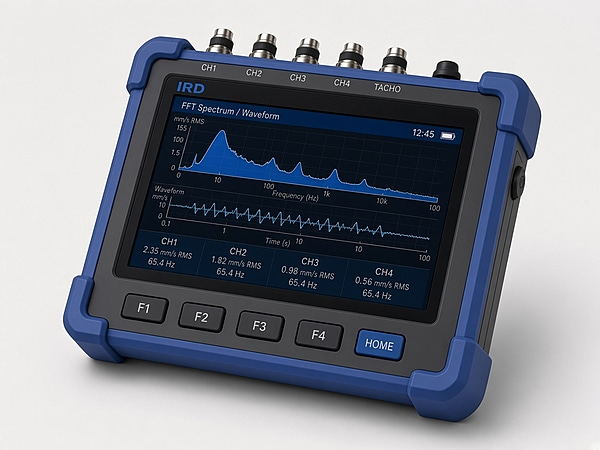
dataPAC 2040 is a compact, rugged four-channel analyser and data collector for route-based condition monitoring, machinery diagnostics and field balancing. Lead time: 2 months from order.
Product Details
Preliminary technical specification · November 2026
dataPAC 20404-Channel Portable Vibration Analyser & Data Collector
dataPAC 2040 is a compact, rugged four-channel analyser and data collector for route-based condition monitoring, machinery diagnostics and field balancing. For a simpler triaxial meter without diagnosis, see the IRD 3V.
Automatic fault diagnosis
The dataPAC 2040 checks recorded data for 16 machine faults automatically. Each finding comes with a severity, a confidence percentage, the evidence behind it and a recommended action, set against the ISO 20816 zone. Findings under 40% confidence are held back.
Machine faults: unbalance; angular misalignment; parallel (offset) misalignment; structural looseness; rotating looseness; bent shaft; eccentricity; resonance (given as a hint, to be confirmed by a run-up, coast-down or bump test).
Bearing defects: outer race (BPFO); inner race (BPFI); rolling element (BSF); cage (FTF). Bearing checks use a built-in bearing catalogue.
Drive train and process: gear mesh faults (needs the tooth count); electrical faults at 2× line frequency (needs the line frequency); belt faults (needs the belt geometry); vane or blade pass and cavitation or flow turbulence (needs the vane count).
Coupling misalignment checks using the 180° phase test need a second measurement point.
4 + tacho
Simultaneous
dynamic channels
dynamic channels
80 kHz
Frequency range,
single channel
single channel
25,600
FFT lines,
single channel
single channel
7-inch
Colour IPS
touchscreen, landscape
touchscreen, landscape
IP65
With connector
caps fitted
caps fitted
≥ 10 h
Battery life,
typical route use
typical route use
Features
Route data collection
Overall, spectrum, waveform and gSE captured together in one record.
Bearing demodulation
gSE (spike energy) bearing demodulation and multi-band envelope demodulation.
Field balancing
Single- and two-plane field balancing, using up to four sensors at once.
Inputs
| Dynamic channels | 4, acquired simultaneously |
|---|---|
| Tachometer / phase reference | 1 dedicated input. Optically isolated; auto or adjustable trigger; 1 to 300,000 RPM. 5 V supply for a laser tachometer and a strobe-trigger output. |
| Sensor power | IEPE / constant-current, selectable 0 / 2 / 4 mA at 24 V, with bias-voltage and cable-fault check |
| Other signal types | AC voltage (±10 V); DC voltage including proximity-probe gap (0 to −24 V and ±24 V); 4–20 mA; velocity-coil transducers |
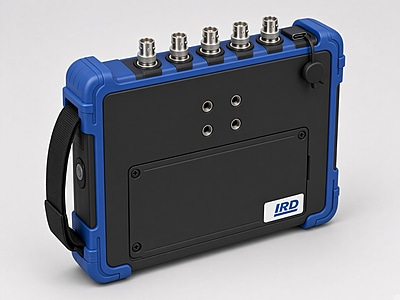
| Connectors | BNC bulkheads for CH1, CH2, CH3, CH4 and TACHO, plus a USB-C port with a tethered sealed cap. All six connectors are on the top edge and point upward. |
| Triaxial sensors | Supported on three channels |
Measurement & analysis
| Analogue-to-digital conversion | 24-bit, simultaneous sampling on all four channels. Dynamic range ≥ 110 dB. |
|---|---|
| Frequency range (Fmax) | Up to 80 kHz on one channel; up to 40 kHz with all four channels active |
| FFT resolution | Up to 25,600 lines on one channel; up to 12,800 lines on all four channels simultaneously. Zoom FFT. |
| Measured quantities | Acceleration, velocity and displacement. Overall vibration to ISO 20816. |
| Core functions | Overall level, frequency spectrum, time waveform, gSE (spike energy) bearing demodulation, multi-band envelope demodulation |
| Phase, orbit and cross-channel | Phase at 1× to n× running speed; orbit; cross-channel phase, coherence and frequency-response (FRF) |
| Advanced diagnostics | Bump / impact test; run-up and coast-down with Bode, Nyquist and waterfall plots; order tracking; time-synchronous averaging (TSA) |
| Octave analysis | Octave and 1/3-octave band analysis, 1 Hz to 20 kHz, linear or A-weighted (designed to IEC 61260-1 Class 1) |
| User-defined frequency bands | Up to 12 per measurement point, set in Hz or in orders of running speed; each band has its own alert and danger limits and is trended in the PC software |
| Route data collection | Overall, spectrum, waveform and gSE captured together in one record, with on-screen alarm colour |
| Field balancing | Single- and two-plane, using up to four sensors at once; 30 to 60,000 RPM; trial-weight calculation; stored influence coefficients for one-shot repeat jobs; trim; split or combine correction weights to fixed positions or blades; ISO 21940-11 tolerance check |
| Windows and averaging | Hanning, flat-top and rectangular windows; linear, exponential, peak-hold and synchronous averaging |
Display & controls
| Display | 7-inch colour IPS touchscreen, landscape orientation. Intended for sunlight-readable, optically bonded, glove-capable use. |
|---|---|
| Keys | Sealed F1, F2, F3, F4 and HOME keys below the display |
| Handling | All connectors on the top edge, clear of the screen and keys. Protective elastomer impact boot. |
Data & connectivity
| Local storage | Internal memory (8 GB or greater) plus microSD expansion |
|---|---|
| Wired interface | USB-C for charging and data. Device and host operation. |
| Wireless | Wi-Fi, 2.4 GHz and 5 GHz |
| Route transfer | Load routes to the instrument and upload measurements by USB-C or Wi-Fi |
Companion PC software
| Platform | Desktop application for Microsoft Windows |
|---|---|
| Functions | Plant tree and route builder; download and upload; trend and alarm exception review; spectrum and waveform analysis (cursors, harmonics, sidebands, waterfall, orbit, Bode / Nyquist); bearing fault-frequency overlay; balancing jobs and reports; report output in PDF, Word and Excel |
| Data exchange | Export to CSV and UFF58; published package format so recorded data are not locked to a single application |
Power
| Battery | Rechargeable lithium-ion pack, which can be swapped in the field |
|---|---|
| Charging | USB-C, including USB Power Delivery |
| Operating time | ≥ 10 hours typical route use on one charge |
Mechanical & environmental
| Enclosure | Handheld industrial housing with a protective elastomer impact boot. Dark housing with a blue boot. |
|---|---|
| Instrument | dataPAC 2040 is supplied in the protective impact boot. |
| Dimensions | 215 × 150 × 46 mm (housing). 221 × 156 × 54.3 mm with the impact boot fitted. |
| Weight | ≤ 1.1 kg including battery |
| Ingress protection | IP65 with connector caps fitted |
| Operating temperature | −10 to +50 °C |
| Drop resistance | 1.5 m onto concrete |
| Compliance | Designed for EMC (EN 61326-1), electrical safety (IEC 61010-1) and rechargeable-battery safety and transport (IEC 62133 and UN 38.3, with applicable national registration). Certification planned. |
Preliminary technical specification, November 2026. Specifications are subject to change without notice.
IRD Mechanalysis Limited
Request a quote for dataPAC 2040, or download the sales brochure.
Lead time: 2 months from order.